

Adoption and Use of AI in Education | Sujoy Bhattacharya
Whether we like it or not, Artificial Intelligence is here to stay and influence our lives and our workplace. It’s a part of the natural progress of technology and must be embraced. Early adopters are likely to be at an advantageous position.
How are we assimilating AI in Education today?
While there is a good amount of positive vibe regarding the adoption of AI in industry practices, the approach seems to be very cautious in the education sector. While it is true that there is a drive to ‘learn’ AI all levels, the implementation and ‘use’ of AI seems to be lagging behind.To illustrate, we do see school education boards like CBSE include courses that include Computational Thinking, logic building, problem solving and pattern recognition right from class 3 onwards and more direct subjects like Artificial Intelligence, Natural Language Processing, Neural Networks and Data Science in higher classes. Higher education, especially Engineering and Management education, has introduced full-fledged degree programs and specializations in Artificial Intelligence and Machine learning.However, if we analyze the syllabus of the above courses, we see that they principally deal with topics that range from ‘What is AI’ to ‘How AI Works’. This approach encourages students to become AI Developers, rather that AI Practitioners.
Expected outcome
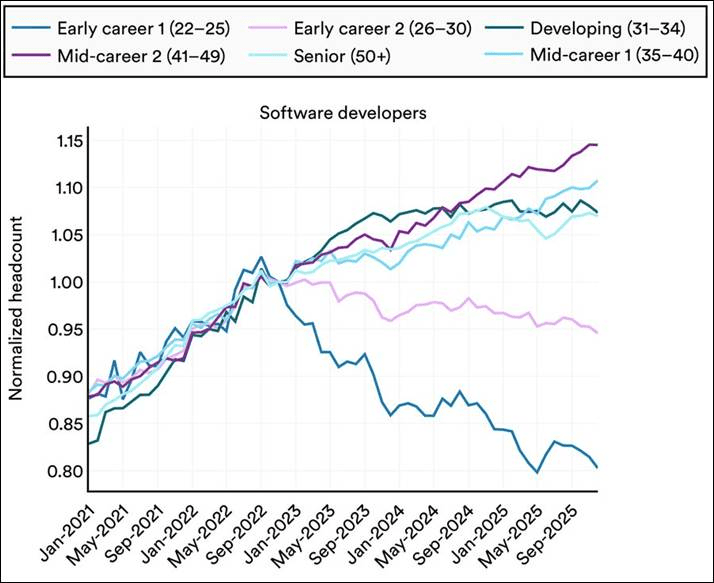
The outcome of this policy seems to be doubtful, if we equate the demand against supply. How many AI Engineers do we actually need? With over 5.25 Lakh AI/ML Engineers being churned out of Indian Engineering Colleges alone, does the industry have the appetite to absorb them? How many of these engineers will get a chance to work in the AI Labs of Google, Microsoft, OpenAI, Enthropic, Meta, Nvidia or the other firms (in India and abroad) that work and develop AI tools? With over 27.5 Lakhs qualified professionals out there as of March 2026 (in India alone) and the number growing rapidly y-o-y, this sector looks pretty crowded and the inevitable saturation is not far away. Just to put the numbers in perspective, the overall demand for AI Engineers in 2026 is expected to be around 10 Lakhs, which is far smaller than the available pool.The following graph adequately explains the impact on early-career software developers (including AI Engineers) between 2022 and 2025 due to the rise in use of Gen AI.
Source: Brynjolfsson et al., 2026 AI Index Report
Is there a way to better use the AI boom?
Instead of taking everyone into the depths of what goes into AI, the education community must focus on using AI to increase productivity of operations, right from school level. There are various ways AI can be leveraged for windfall gains across all industries. Some of the areas that we should educate our students on are:
Use AI to improve engineering processes:
All engineering disciplines, including core branches like Electrical, Electronics & Communication, Mechanical, Civil and Chemical Engineering, along with allied branches, must harness the power of AI to improve on traditional design and processes leading to safer and more efficient operations. The industry sector that absorbs these engineers do not need employees who know the insides of an LLM but one who can integrate the existing LLM’s and AI tools (with their inbuilt agents) into their day-to-day work. In today’s higher education institutes, Computer Science and Engineering (with specializations) disciplines are completely isolated from Core disciplines whereas they should be merged. Multidisciplinary programs on AI Applications must be introduced. Only then would we see the effective use of AI in practice.
Use AI to improve management processes
Just like engineers, modern managers need to learn and adopt the use of AI for decision making and analysis. Use of tools like Jira (task management), Wrike (Project workflows), Monday.com (resource planning), Zoho Projects (overall project management) and many more are becoming essential for all corporate managers. They not only help to manage repetitive and complex project work breakdown structures but also helps to read between the lines and predict outcomes that a busy manager might otherwise miss. At least a couple of courses dealing with these tools must be included in BBA and MBA courses to create awareness and value among graduates.
Use AI for scientific research
There is a wealth of online information available on any topic today. Existing AI systems have an answer (may not always be 100% accurate, but we will get there soon) to any question on any subject, be it science, arts / humanities, social science, commerce or law. But this knowledge pool is largely untapped as the researchers are not trained on efficiently searching this ocean of information for relevant data. Even today, the use of AI among the academic community is limited to Google-like searches on ChatGPT, Gemini, Copilot and similar tools. Very few researchers are aware of tools like Perplexity, iAsk, Felo AI or Consensus, which are extremely powerful engines, all with free plan options.
Use AI enabled tools to increase personal efficiency
This is perhaps the fruit hanging on the lowest branch but somehow is one that hasn’t been plucked yet. Research efficiency can be increased manifold using tools like Claude for creating research documentation, Napkin.ai for creating visual representations of complex outcomes, Perplexity for searching the latest information and NotebookLM for analysing volumes of past research. Teachers can improve their teaching capabilities using GammaAI for creating high-quality presentations or Napkin.ai for explaining complex processes through visual representations. Students can use Google AI Studio for personal tutoring, GitHub, Codex, Cursor or Replit Agent for code generation and Offergoose or Huru for interview preparation in addition to other tools mentioned above. In addition to the above, a number of efficiency improvement platforms like Jira, Asana and Primavera are available for managing classes, projects and individual progress / results.
Conclusion
In order to ensure success for our students, we need to provide education that will ensure their success in the discipline of their choice. A change in thinking is necessary to focus on the use of AI rather than developing AI, the latter being reserved for a select few. Additionally, efficiency of the teaching-learning process can be improved manifold through proper use of tools, leaving more time for problem-solving and diversification. This balanced approach is necessary to ensure student success and industry satisfaction. Tell me what you think. How can we equip a greater percentage of students to adopt and learn AI and ride the wave to success? How can we engage non-technical degree students with high-tech developments? How can we brand AI as a job-creator rather than a job-taker?
